
Generative Design for Sheet Metal Structures – Further Development of a Knowledge-Based Design Algorithm
- Subject:AI, Generative design, design methodology, sheet metal design
- Type:Bachelor / Master Thesis
- Tutor:
Generative design can significantly accelerate the early exploration of engineering design solutions. In practice, however, many generated concepts fail to meet manufacturing requirements, as the generation process often lacks the domain-specific design knowledge that experienced engineers apply during product development.
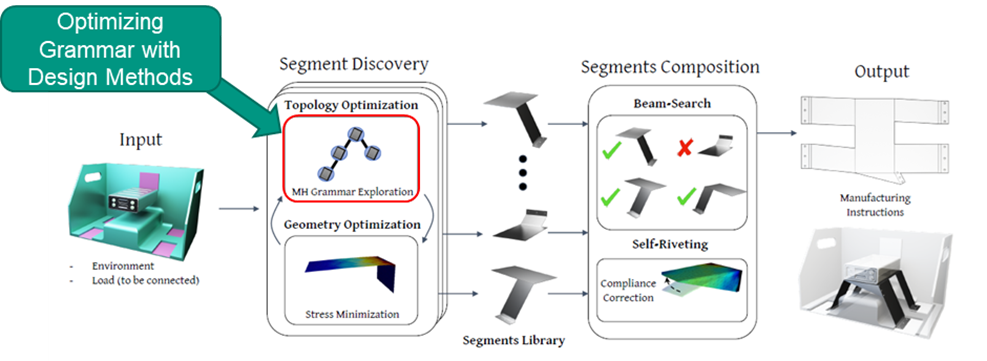
To address this challenge, the institute developed SheetGen, a rule-based generative design algorithm for sheet metal bending parts. The algorithm systematically integrates domain-specific design knowledge directly into the generation process. Manufacturing requirements are embedded at different stages of the algorithm (pre-processing, in-process, and post-processing). Generated solutions can be automatically exported to a CAD environment and further analyzed.
Task:
The goal of this thesis is the further development and extension of the existing SheetGen algorithm. Possible focus areas include:
-
Extending the approach from single parts to assemblies
-
Expanding the rule-based knowledge integration
-
Developing or extending a CAD interface (e.g., Onshape)
-
Integrating simulation or evaluation methods (e.g., FEM or manufacturing simulation)
-
Improving the visualization and analysis of generated design spaces
The exact focus of the thesis can be adapted depending on the student's background and interests.
Profile:
-
Interest in generative methods, CAD, or simulation
-
Programming experience (e.g., Python) is an advantage
-
Studies in Mechanical Engineering, Mechatronics, Computer Science, or a related field
- You work purposefully, independently and autonomously